
 企业平台
企业平台 发现评估
发现评估 自动化
自动化 AI+自动化
 行业解决方案
 业务解决方案
 合作伙伴
合作伙伴 生态联盟
生态联盟 咨询服务
咨询服务 培训服务
培训服务 交流社区
交流社区 客户成功
客户成功 产品文档
产品文档
 公司介绍
公司介绍 新闻列表
新闻列表 联系我们
联系我们 加入我们
加入我们

In the face of increasingly fierce business competition, is the enterprise still trapped in a mechanically repetitive process? As soon as the system is updated, the automated script will fail; When the enterprise process rules are adjusted, the system needs to be reconfigured; The more manpower is invested in maintenance, the less efficiency is improved?
RPA has always been a "competent person" for enterprises to reduce costs and increase efficiency. It has ended countless repetitive work with precise implementation and has become a landmark technology for digital upgrading. Nowadays, with the rise of agent, automation technology is facing a critical change.
Deon van niekerk, chief technology officer of ovations technologies, said: "the real productivity revolution must be the synergy of cognitive decision-making and precise execution."
The deep integration of agent and RPA has formed a clear division of labor of "agent understands business and RPA understands execution": agent converts unstructured data into clear instructions, RPA completes stable and controllable batch operations in the enterprise system, realizes the leap from single point task automation to multi scenario value delivery through clear division of labor, and is promoting enterprise business from "intelligent change" to "qualitative change".
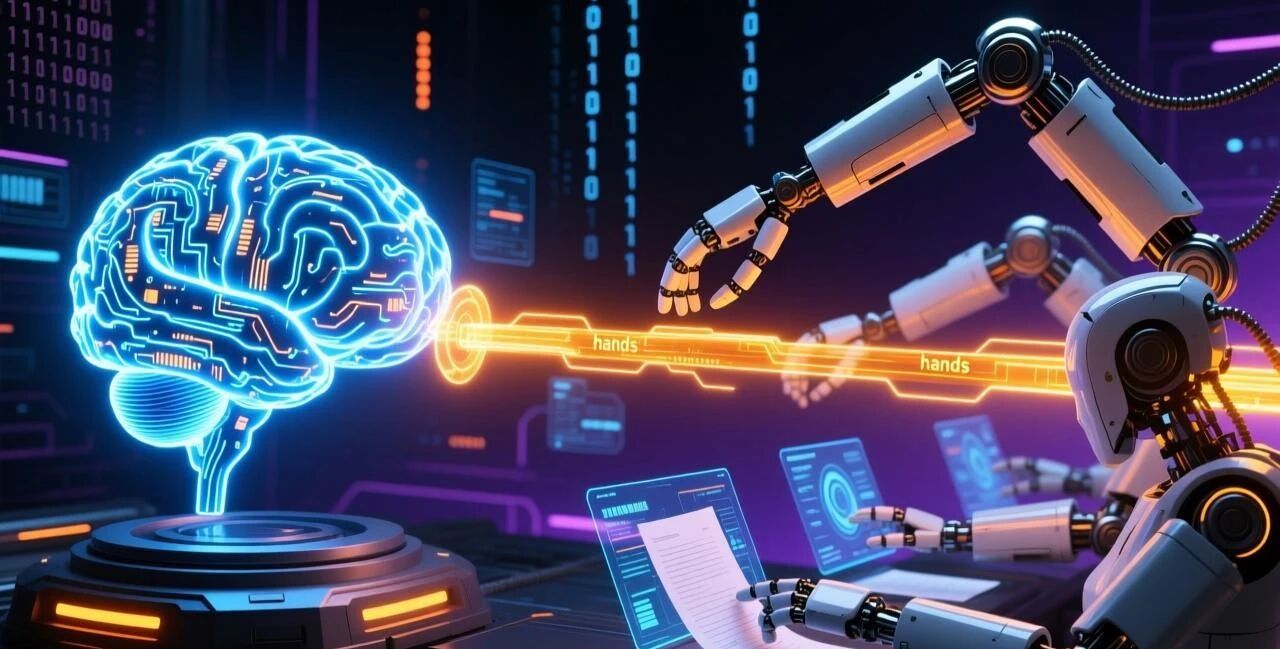
RPA+Agent,1+1>2
The evolution of automation technology has always been centered on the core demand of "emancipating manpower". From the early script automation, to the visual process construction of RPA, to the current agent driven multi scenario efficiency improvement, each iteration stems from the urgent need of enterprises for efficiency improvement.
With the advent of the era of intelligence, enterprises' demand for automation has gone beyond "replacing repetitive labor". Taking business as the core, combined with the precise implementation of processes, has become the key for enterprises to release digital productivity.
When RPA becomes the industry standard configuration, simple efficiency improvement can no longer build a competitive barrier for enterprises. Enterprises need to create an advantage that cannot be replicated through the continuous evolution of RPA.
With the development of RPA, its value for business has evolved from "efficiency improvement tool" to "business enabler". Through the technical integration with AI, it provides important support for supporting business innovation and achieving sustainable development.
When RPA meets agent, the complementary integration of "hands and feet" and "brain" becomes the best way for enterprises to improve automation efficiency. The agent is responsible for "understanding" and "thinking clearly", and the RPA is responsible for "doing it right, doing it, and replying". The two cooperate to open up the whole automation link in the intelligent era.
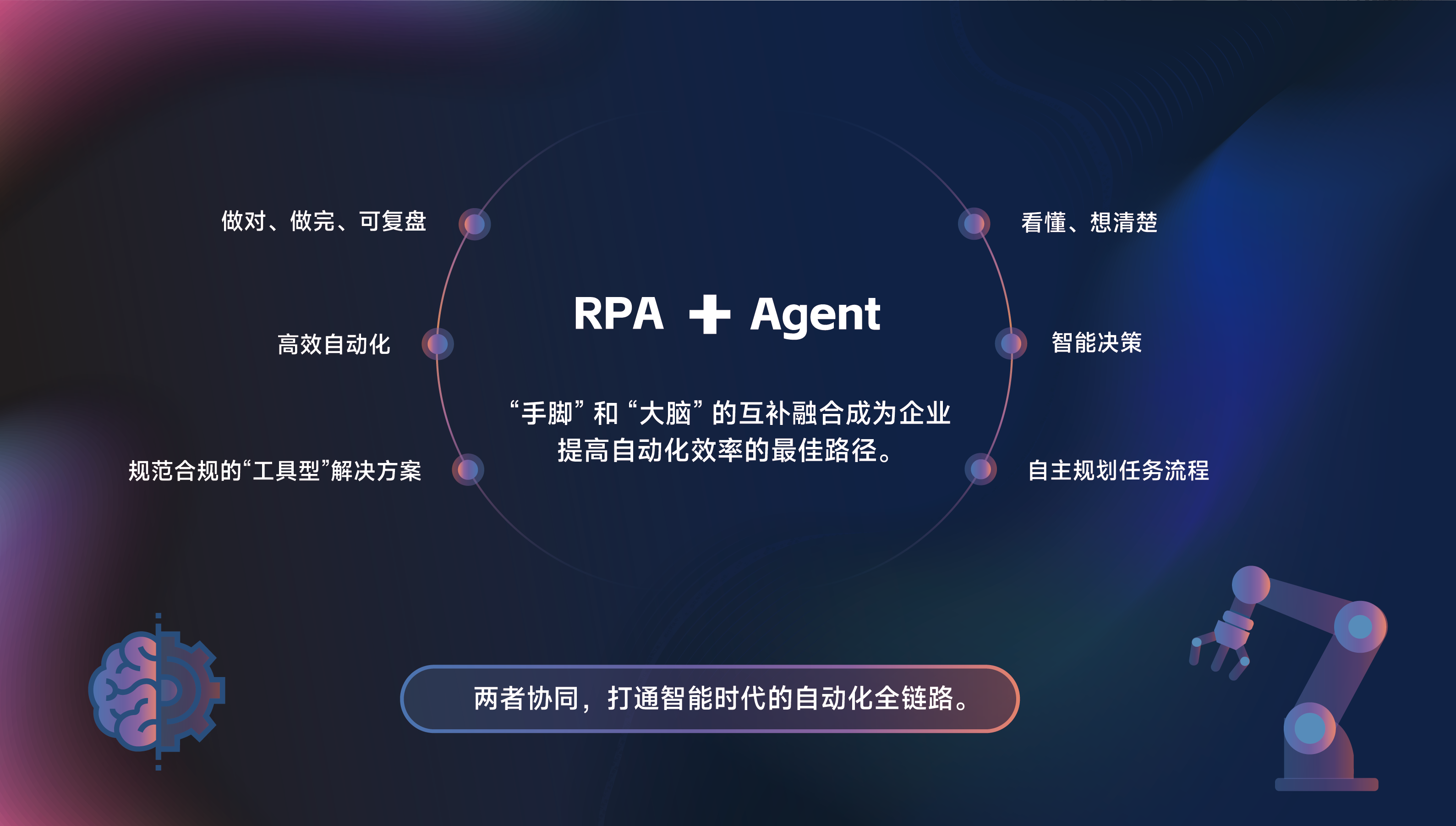
As the role of intelligent "brain", agent is good at intelligent decision-making in complex scenes based on the autonomous decision-making ability of AI.
Agent has powerful cognitive and decision-making ability, can understand the intention of natural language, process unstructured data such as contracts and emails, and independently plan the task process according to the real-time situation.
Even in the face of abnormal conditions such as system errors or interface changes, the agent can adjust dynamically through reasoning, which significantly improves the stability and adaptability of automation.
RPA, on the other hand, is an agile "hand and foot". Its advantages focus on the efficient automation of standardized processes. It is a "tool" solution for enterprises to reduce costs, increase efficiency and standardize compliance.
RPA is designed for a structured process with clear rules and high repeatability, which simulates human operations on the computer (such as data entry, form filling, system reconciliation, etc.), and realizes the full automation of the process.
Its deployment cycle is short and the initial investment is low. Through zero code/low code deployment, enterprises do not need to transform the existing IT system, and can quickly adapt to standardized scenarios such as financial invoice review, HR human process, e-commerce order processing, and do not need the deep participation of professional technical teams. Small and medium-sized enterprises can also quickly apply it, significantly reduce human operation errors, and reduce human costs. It is a powerful tool for enterprises to reduce costs and increase efficiency.
The evolution of RPA+agent is essentially the transformation of RPA from "tool attribute" to "partner attribute". It is no longer the "executive assistant" of human beings, but an "intelligent colleague" who can understand business logic, adapt to dynamic scenarios and solve complex problems cooperatively.
This collaborative mode of "agent making decision and RPA making execution" is enabling enterprises to comprehensively advance in the direction of business intelligence.
Focus on the scene to release value
IDC report shows that in 2025, the deep integration of RPA and AI is becoming the core engine to reshape enterprise operation efficiency. Research shows that the market size of rpa+ai solutions in China has reached 2.47 billion yuan in 2023, and is expected to exceed 7billion yuan in 2026.
Gartner defines the integration mode of AI and RPA as "composable automation", whose core is to dynamically arrange digital employees like building blocks to respond to market changes quickly.
In this mode, enterprises can flexibly combine agent, RPA, data analysis and other capabilities according to business needs to build personalized automation solutions without developing from scratch.
The development from RPA to rpa+agent is not only the technical iteration of automation tools, but also the leap of intelligent productivity from "process execution level" to "decision coordination level", marking that human-computer collaboration has entered a new stage. The practice of i-Search is a typical representative of this direction.
In October last year, i-Search's enterprise level automation platform was upgraded again. Through the three major technical capabilities of AI center, agent+rpa integration and intelligent components, it completed the transition from "process automation" to "independent collaboration of agents". It not only retained the stability and efficiency of RPA, but also gave automation the intelligent attribute of "active decision-making and flexible collaboration", helping enterprises to build a more adaptive digital business system while reducing costs and improving efficiency.
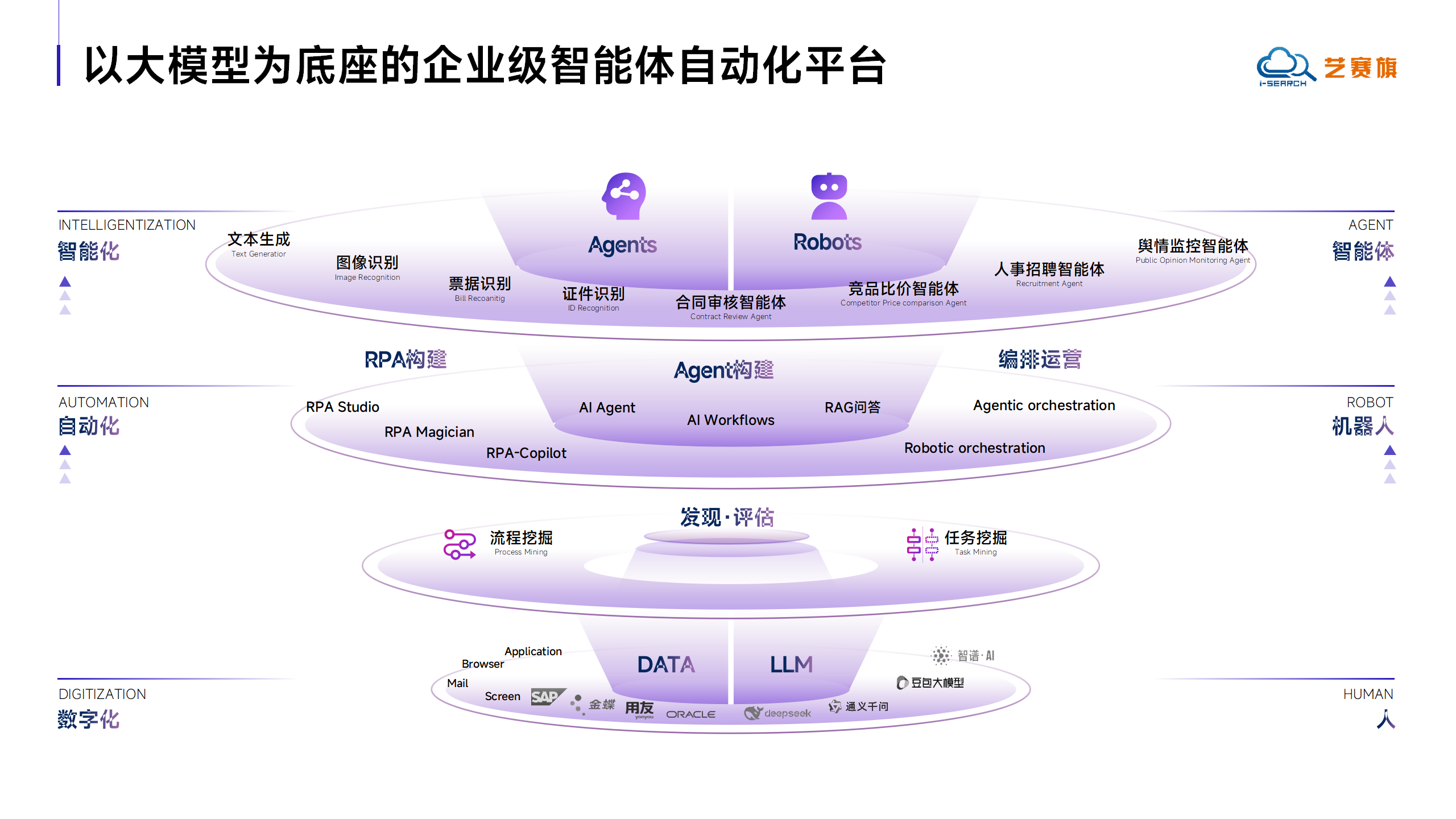
As the core module of this upgrade, AI center realizes the full custom adaptation of agents and business processes, and its technical capabilities cover the construction of zero code and low code dual-mode agents.
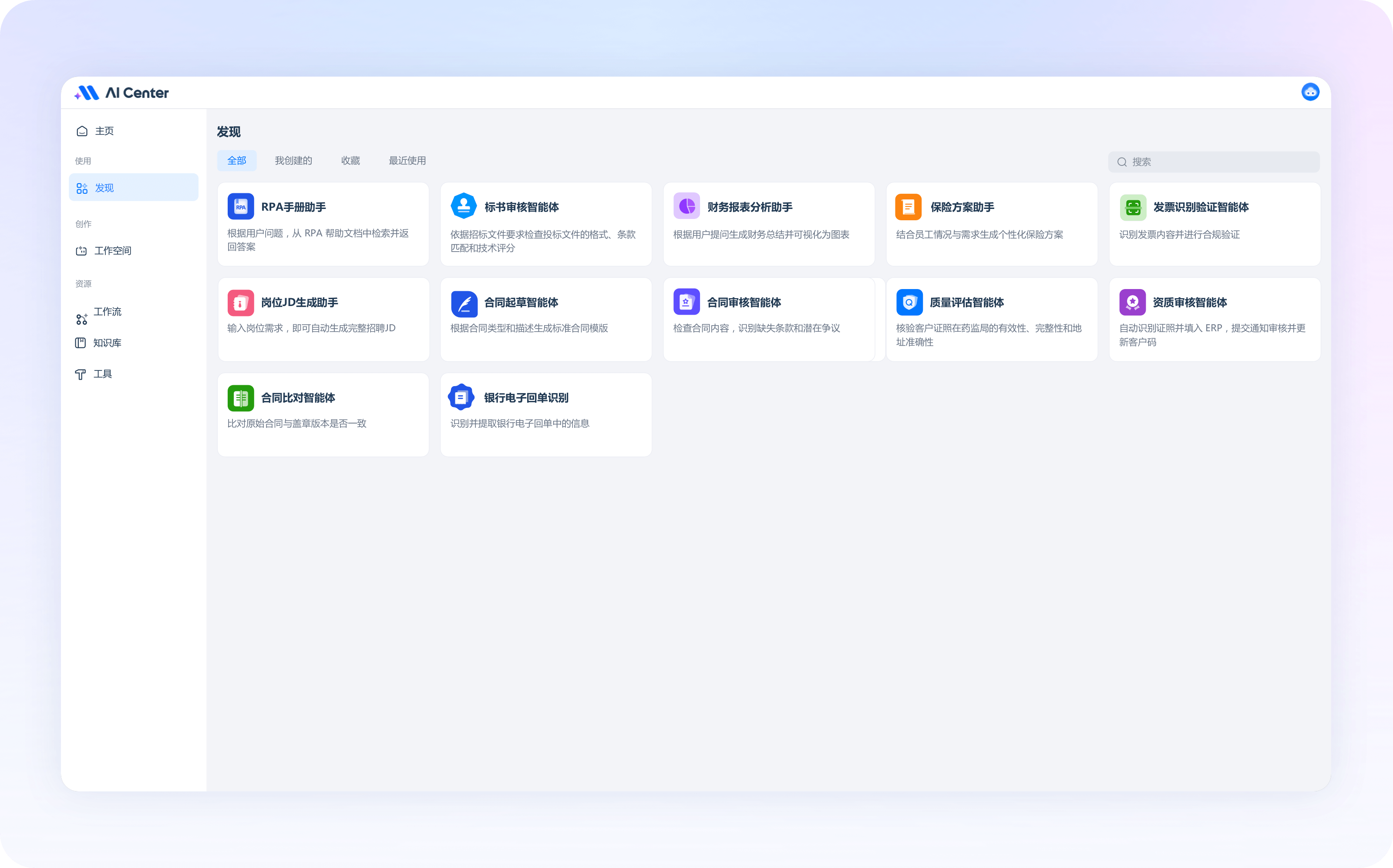
As the core module of this upgrade, AI center realizes the full custom adaptation of agents and business processes, and its technical capabilities cover the construction of zero code and low code dual-mode agents.
Zero code construction supports enterprise users to independently configure internal tools and data interfaces called by agents through visual interfaces, and can quickly build agents that can solve complex business tasks without technical background.
Low code development provides a drag and drop operation interface, supports the plug and play of mainstream large language models (such as GPT, tongyiqianwen, etc.), and significantly reduces the development threshold of agents.
This module upgrades automation from "passively executing instructions" to "actively understanding intentions and autonomous decision-making tasks". For example, an agent can automatically identify abnormal data in financial statements and actively call RPA process to complete traceability and correction.
The integration of agent and RPA realizes the seamless collaboration between agent and process. Through the deep technology integration of is RPA designer and AI center, a two-way cooperation mechanism of "agent scheduling process+process calling agent" is constructed.
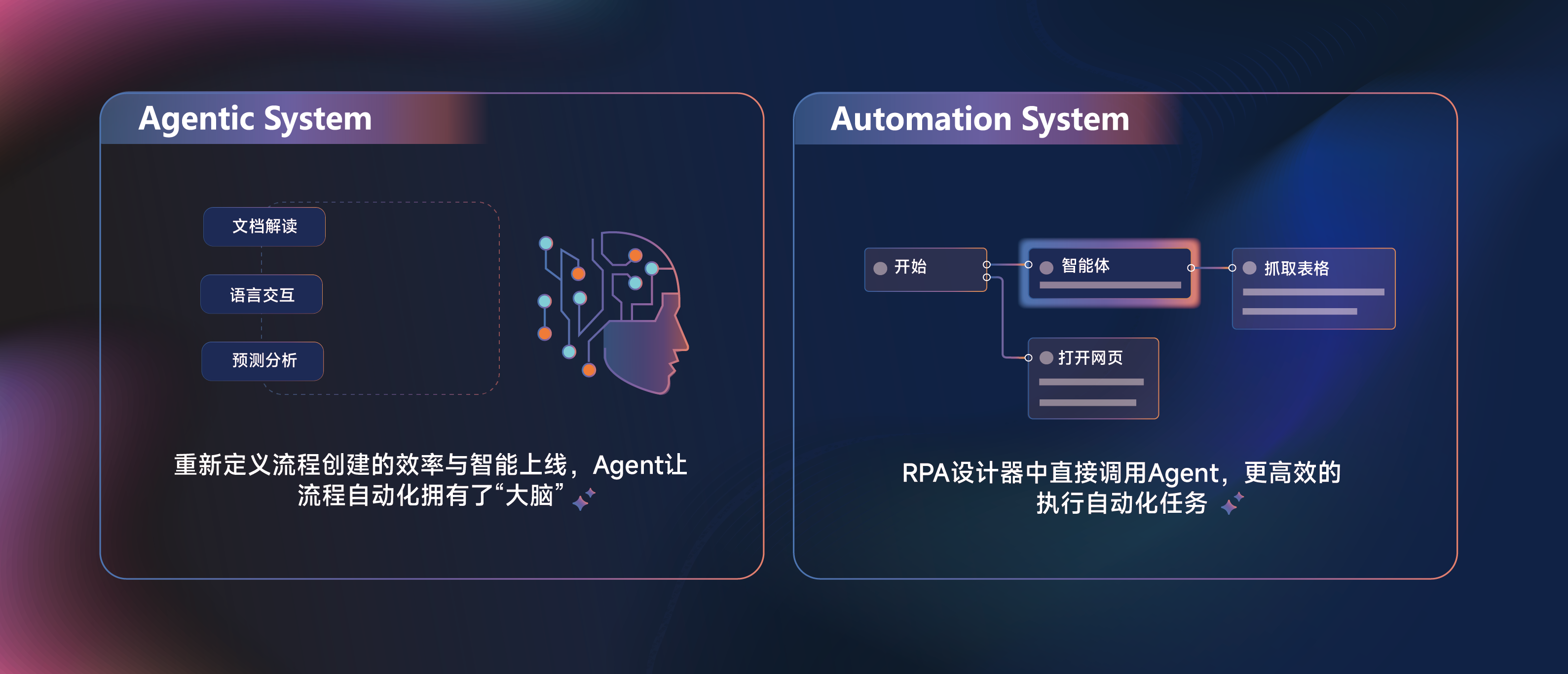
On the one hand, the agent can independently call the preset RPA process library (such as contract review process and invoice verification process) according to the dynamic requirements of the business scenario, so as to realize the intelligent arrangement of business logic and avoid manual intervention in process connection.
On the other hand, in the process of RPA implementation, if you encounter non standardized tasks (such as emotional analysis of customer e-mails and extraction of unstructured data), you can directly dispatch the agent to complete the decision, making the automation process from "mechanical implementation" to "flexible response".
This approach breaks the technical boundary between agents and automated processes. It is not only the integration of functions, but also the evolution of paradigms, so that each business process has the dual ability of "thinking+executing".
For example, in the procurement process, the agent can first analyze the demand priority, and then dispatch the RPA to complete the supplier price comparison and order.
In order to further reduce the threshold of automation development, i-Search introduced a new intelligent component system to realize natural language driven development with the understanding and reasoning ability of large language model as the core.
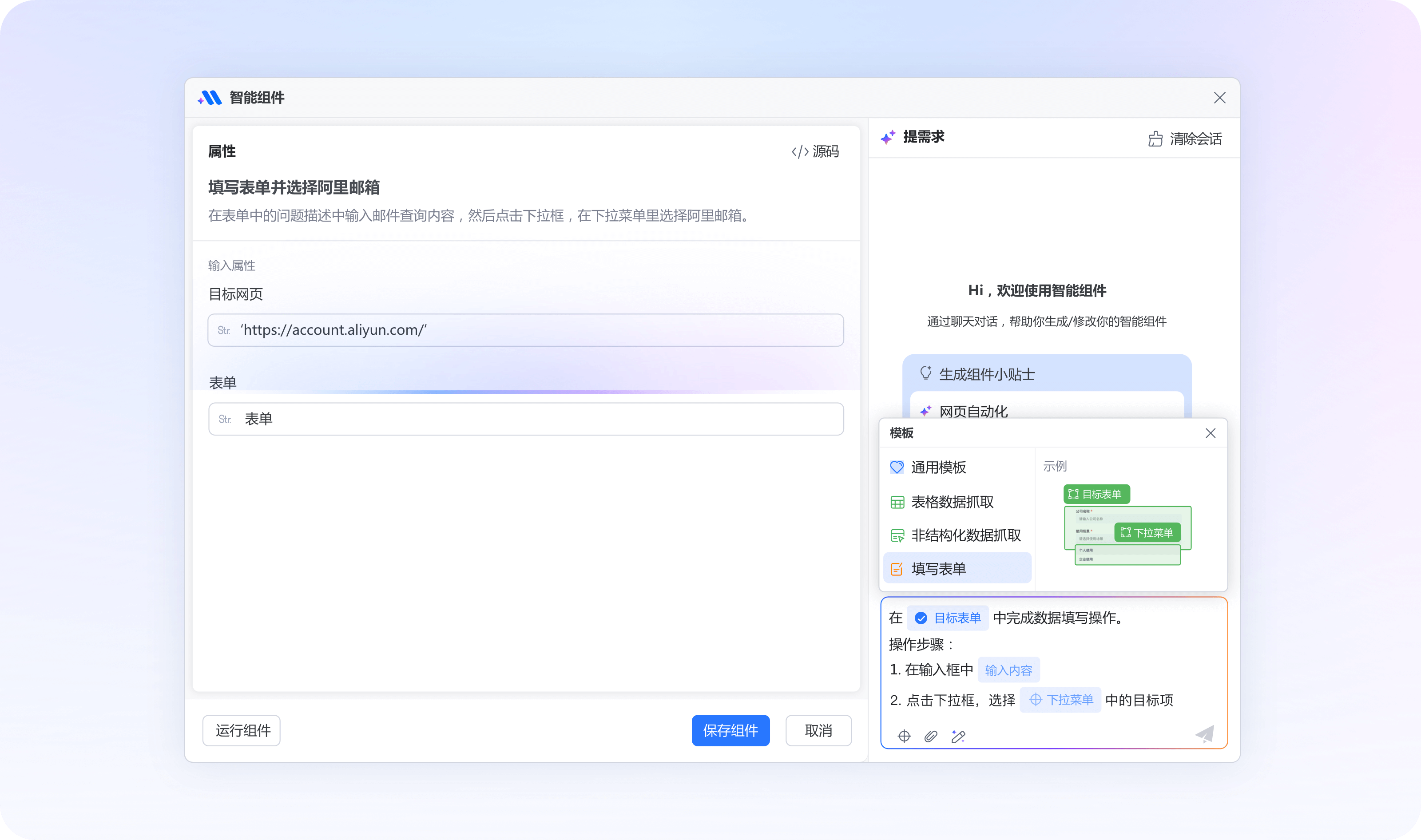
Through natural language instructions, the system can automatically identify web page elements, complete table capture, data extraction, form filling and other operations, replace the previous RPA "screen recording configuration", and significantly reduce the development cost of web page operations.
Non technical personnel only need to describe the business requirements in words to complete the construction of automated processes, and truly realize "can express can develop".
Intelligent Collaborative breakthrough boundary
From the mechanical execution of RPA to the intelligent collaboration of RPA+agent, each iteration of automation technology is breaking through the boundary of enterprise business automation and realizing the core transition from "process automation" to "business intelligence".
As an important productivity tool in the digital era, RPA is changing the operation mode of enterprises at an unprecedented speed.
From basic process automation to the deep integration of intelligence, RPA continues to evolve, bringing many advantages for enterprises, such as efficiency improvement, cost reduction, risk control and so on.
Looking forward to the future, with the continuous innovation of technology and the continuous expansion of application scenarios, RPA will play a more important role in the process of digitalization and intelligence of enterprises. By deeply integrating the automation system into the core business links, RPA will become the key support for enterprises to enhance their core competitiveness and respond to market changes, and inject a continuous stream of innovation power into the development of enterprises.
