
 企业平台
企业平台 发现评估
发现评估 自动化
自动化 AI+自动化
 行业解决方案
 业务解决方案
 合作伙伴
合作伙伴 生态联盟
生态联盟 咨询服务
咨询服务 培训服务
培训服务 交流社区
交流社区 客户成功
客户成功 产品文档
产品文档
 公司介绍
公司介绍 新闻列表
新闻列表 联系我们
联系我们 加入我们
加入我们

With the continuous promotion of the national "belt and road" initiative, more and more Chinese enterprises are sailing to the sea. However, while expanding the business boundary, enterprises are also facing the inevitable challenge in transnational operations - document processing.
In the face of purchase orders, invoices, customs declarations and other documents with different formats, languages and rules, manual verification takes a long time and has a high error rate, which has become a key bottleneck restricting the efficiency and safety of going to sea.
So, is there a solution that can effectively, accurately and legally solve this global problem? The deep integration of AI and RPA technology is providing new answers for overseas enterprises.

Document processing
"Invisible cost" that cannot be ignored by enterprises
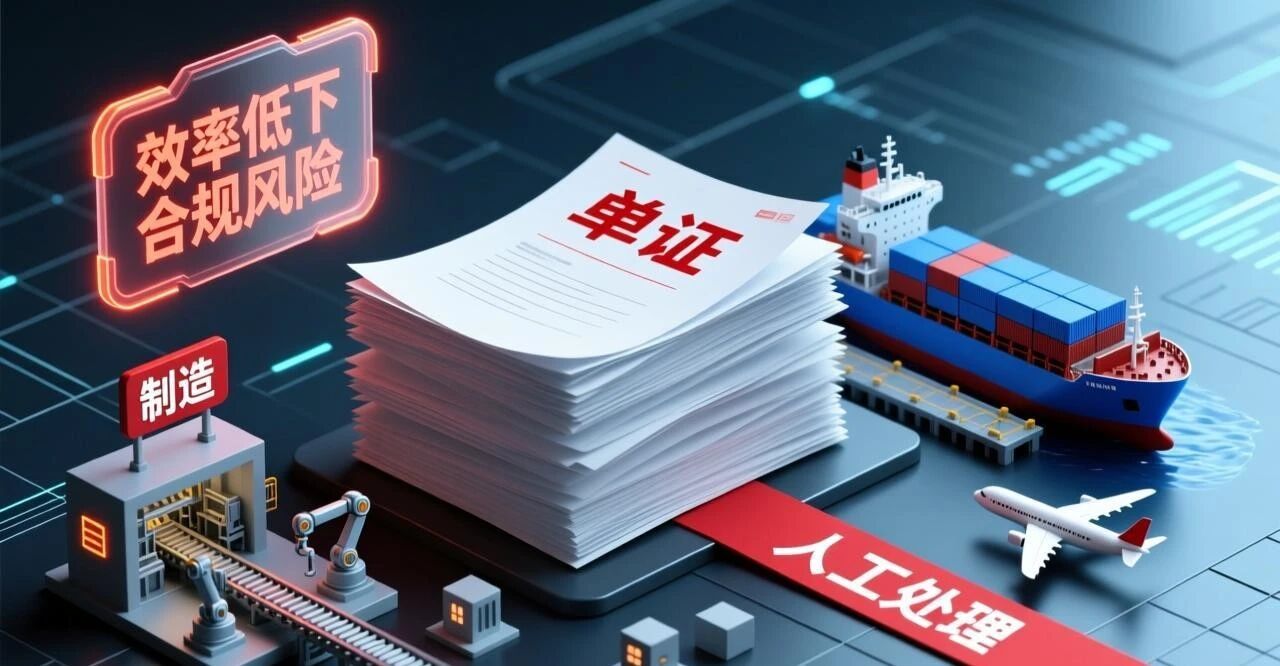
In manufacturing, foreign trade, logistics and other industries, documents are the core link through the business. However, its processing process relies on manual work for a long time, which is not only inefficient, but also hides huge operational and compliance risks.
When the business scenario extends from home to abroad, the problem is dramatically magnified: European and American invoices, East Asian customs declaration forms, South American handwritten tax receipts... Various non standardized documents make manual verification time doubled, and a minor spelling error may lead to customs clearance failure or financial loss.
In the past, enterprises have tried to realize automation with the help of OCR and other technologies, but traditional OCR can only recognize characters and cannot understand the meaning and logical relationship of fields. In the face of diversified actual business documents, it is difficult to guarantee the recognition accuracy.
When enterprises try to use the "semi-automatic" method of OCR+manual verification+system manual input, although some problems can be solved in the short term, once the business volume increases, the error rate and processing cost will double, which is difficult to support enterprises to move towards large-scale and refined operation.
Therefore, breaking the bottleneck of document processing is not only a technical problem to improve efficiency, but also a strategic key to whether overseas enterprises can build core advantages in global competition.
From "identify document" to "process"
Paradigm change of agent+RPA
In fact, the key to solving this pain point is to break the existing fragmented and rigid tools, and seek an integrated and intelligent automation scheme, so that enterprises can move towards a more efficient operation mode.
Li Bo, general manager of i-Search solutions department, believes that the essence of enterprise document processing is not just to identify documents, but to complete a set of business actions.
Truly effective document processing automation must be upgraded from "identification document" to "processing process", covering the whole process from document acquisition to business system update. In this process, the collaboration between RPA and AI agent is becoming the core capability to realize the paradigm transition of automated processing.
Based on this concept, i-Search has completed the upgrading of the automation platform again in October last year, and has achieved a leap from "process automation" to "independent collaboration of agents" through the three major technical capabilities of AI center, agent+rpa integration and intelligent components.
For the document processing scenario, i-Search's "agent+rpa" integrated solution not only retains the stability and efficiency of RPA, but also endows the agent with the intelligent attribute of "active decision-making and flexible cooperation", which promotes the document processing from point capability to end-to-end automation.
Among them, agent plays the role of "brain".
It is not an OCR engine in the traditional sense, but a multimodal recognition and understanding ability for complex document scenarios. It not only has the powerful recognition ability of cross language, cross format and cross standard, but also can understand the content and structure of different types of documents, and judge the meaning of fields, find exceptions and make processing decisions in combination with business rules.
The RPA, as a "hand and foot", is responsible for performing specific actions stably and efficiently.
Unlike the traditional manual operation method, RPA can automatically complete the acquisition of documents, including automatically obtaining e-mail, scanned copies or photo attachments, logging into various business systems, and completing voucher preparation, entry, verification, comparison and other operations.
The collaboration between the two makes it possible for the first time to automate document processing end-to-end: from the entry of documents into the enterprise to the entry of data into the business system, manual repeated operations and checks are no longer required.
At the same time, through continuous feedback and optimization, the automation system forms a self evolving closed loop.
More importantly, i-Search did not turn this set of capabilities into an IT project of "re development and re delivery".
Through the configuration mode of zero code and low code, business personnel can participate in the construction and optimization of document process, which enables automation to continuously evolve with the business.

Head enterprises take the lead in verifying
From "manual verification" to "unattended"
In fact, the document processing automation scheme based on "agent+rpa" such as i-Search is not a "concept first" technical experiment.
On the contrary, it is those globalized enterprises with complex business, huge amount of documents and high requirements for accuracy and timeliness that really promote this round of technological evolution.
In manufacturing, foreign trade, logistics, insurance and other industries, leading enterprises have taken the lead in "eating crabs".
As a group supply chain service enterprise with a large number of overseas businesses, Youhe group is a representative case of this model in real and complex businesses.
Youhe needs to process a large number of purchase orders, customs declarations and related emails every day. The documents come from many sources, have different formats, and involve multiple core business systems.
In the past, these works were highly dependent on manual judgment and entry item by item, which was not only inefficient, but also the error rate increased significantly during peak periods.
In the co creation with i-Search, the two sides introduced the agent+rpa deep collaboration scheme based on the large model around the scenarios of e-mail processing, document identification, document review and document preparation.
For example, in the "intelligent mail processing" scenario, RPA automatically gets the mail, forwards it to the agent, automatically parses the mail body and attachment content, judges the business intention, identifies the order or customs declaration related documents contained therein, and completes automatic classification and key information extraction.
Subsequently, RPA takes over the process execution and automatically initiates the corresponding business process. After the launch, the processing time of a single mail is shortened from 4 minutes to less than 1 minute, and a large number of repetitive mail sorting and preliminary judgment work are unattended.
In the "intelligent document processing" link, Youhe faces typical non standardized challenges.
The agent based on multimodal ability can understand the semantics of documents in different formats, achieve accurate table information recognition, and the accuracy of key field recognition is stable at more than 95%.
The system supports the processing of nearly 3000 characters in 2 seconds, and can process about 8000 documents per day, providing a stable data base for subsequent business flows.
In the "intelligent document review" scenario, the agent can automatically complete the cross document information verification, and trigger an intelligent alert once any inconsistency is found.
RPA is responsible for synchronizing the document review results to the system and promoting the process to continue or enter manual review.
In the "one click declaration" scenario, the automation capability is further extended to the core business. Based on the identified and verified data, the system will automatically pre generate the customs declaration interface, and RPA will batch enter the data into the customs declaration system and complete the submission.
On the whole, the labor cost of relevant links was reduced by about 80%, and the efficiency and accuracy of customs declaration were significantly improved.
From mail entry to document processing, document review to document declaration, Youhe group has realized a truly operational and large-scale automated pipeline through the collaboration of "agent+rpa".
In the insurance industry, document processing is also a high threshold scenario.
In a large insurance group, a large number of non standardized materials are involved in the processes of new orders, preservation, claims settlement, etc., such as identity certificates, insurance proposals, medical documents, handwritten signatures, etc.
By introducing the automation capability of agent+RPA, relevant materials can be automatically classified, identified and verified. RPA implements system entry and process flow, significantly improving the efficiency and accuracy of insurance document processing, and laying the foundation for subsequent claims and quality inspection applications.
The practice of these leading enterprises clearly shows that the "agent+rpa" integrated solution is not a technical concept, but a productivity tool that can stably support the operation of core processes in a complex business environment.
Enterprise document processing is gradually moving from "manual verification" to "unattended".

Document processing
Is becoming an enterprise
Entry point of "business intelligence"
Driven by the wave of enterprise digitalization and the strategy of going to sea, the competition of automation is undergoing key changes.
If enterprises want to establish a competitive advantage in the global market, they must build an intelligent automation system with sustainable evolution.
In this trend, document processing, which has always been the basic link through the core business processes of enterprises, is becoming the key entrance to "business intelligence".
Making documents "understood, judged and automatically processed" is the key to improving global operational efficiency and compliance. The integration of agent and RPA provides a feasible path for this problem through the closed loop of "understanding decision execution".
This technology evolution trend is global. Overseas manufacturers such as Rossum are building AI based automation platforms around complex document processing.
In China, manufacturers represented by i-Search deeply integrate AI capabilities on the basis of RPA. Although the starting points of the two paths are different, the direction is the same: let the system have the ability to understand the business, participate in judgment, and continuously optimize.
Compared with single point AI or RPA manufacturers, i-Search's advantage lies in its profound RPA capability and industry delivery experience.
As a long-term leader in the RPA field in China, i-Search is naturally close to the real business systems and processes of the enterprise, which makes i-Search different from a large number of manufacturers that "only do AI and do not do landing". Its AI capability naturally serves the RPA execution layer and can realize the closed loop from "understanding" to "execution".
More importantly, i-Search has the unique advantage of localization. Its scheme has the ability to deeply adapt to the domestic mainstream system, support the information creation environment, and meet the requirements of high-level security compliance. It provides a reliable cornerstone for overseas enterprises to deal with global complexity and ensure data security.
At present, driven by the strategy of going to sea, more and more leading enterprises have begun to cooperate with yisaiqi.
What they pursue is not only the improvement of efficiency, but also a fundamental evolution of the global operation mode of enterprises.
This may be the watershed of the next stage of competition for overseas enterprises.
